March 19, 2026 - 2400 views
Written by Tina Houser
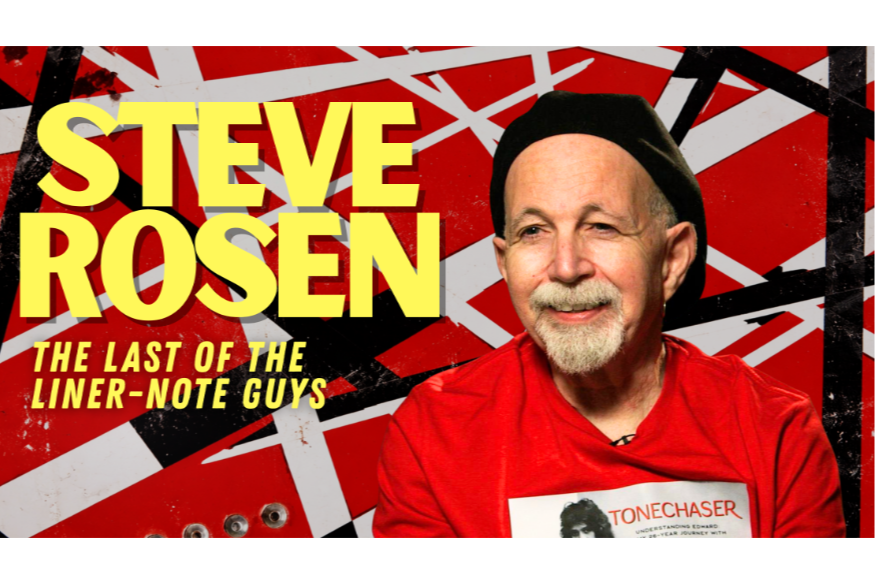
Steven Rosen on Eddie Van Halen, Lost Mystique, and Why Storytelling Still Matters
Steven Rosen didn’t become a music journalist chasing fame. He chased the room — that charged, quiet space where music stops being sound and becomes a person sitting across from you. On Press Play Radio Conversations, Rosen joins Don “The Don” Thatcher, SiriusXM veteran Dean Baldwin, and Press Play CEO Tina Houser for a sprawling, candid reflection on rock journalism, creative intimacy, and what we lost when everything became available all the time.
Rosen has written more than 700 articles for publications like Rolling Stone, Guitar Player, and Guitar World, and is the author of Tone Chaser, his deeply personal account of friendship and fracture with Edward Van Halen. But Rosen doesn’t talk like a man cataloging a résumé. He talks like someone still slightly stunned he was allowed inside the story at all.
The interview that lit the fuse
Rosen knew what he wanted to do the first time he ever interviewed an artist — Joe Cocker, in 1972. He was hitchhiking across the UK, calling publicists from London phone booths with nothing but nerve and curiosity. He admits he wasn’t ready. He admits the interview wasn’t great. But sitting across from Cocker — a man already etched into history by Woodstock — changed something.
“I knew I needed more of this,” Rosen says. Not success. Not status. The moment.
That instinct — chasing connection rather than proximity — is what carried Rosen forward.
Jeff Beck and the mercy that made a career
Every journalist has a nightmare. Rosen lived his early.
Interviewing Jeff Beck for Guitar Player, Rosen realized — after the conversation — that he’d never hit record. Thirty minutes gone. Career over, he thought.
Beck didn’t explode. He didn’t dismiss him. He told Rosen to come back the next day and do it again.
That second interview became Rosen’s first cover story.
It’s a small moment with a big echo: greatness doesn’t always need to flex. Sometimes it just opens the door again.
Journalism as a “filter,” not a transcript
Dean Baldwin frames one of the night’s most important ideas: great music writing isn’t transcription — it’s filtration. Anyone can publish words now. What matters is perspective, the subtle shaping that lets readers feel the artist rather than just read them.
Rosen agrees. That “filter” became critical when writing Tone Chaser. Writing about Eddie Van Halen wasn’t just documenting a legend — it meant navigating friendship, decline, addiction, resentment, and love without turning vulnerability into spectacle.
Rosen waited 17 years after his relationship with Eddie ended before writing the book. The delay wasn’t caution. It was respect.
“The only way to understand Edward,” Rosen says, “was to include the fragile moments.”
When the pedestal cracks
Asked whether knowing artists personally ever kills the magic, Rosen doesn’t hedge.
“Yes,” he says.
By the early ’90s, Rosen felt Eddie change — becoming colder, harder, less kind. The reverence Rosen once carried faded into hurt and resentment. It wasn’t betrayal in the tabloid sense. It was something quieter and more painful: watching someone you loved become someone you no longer recognized.
Baldwin relates from the modern side — how befriending artists you once idolized alters the fan experience. You gain access. You lose mystery.
Rosen calls it “the great conundrum.” Journalism gives you backstage passes and free records — and quietly takes away the ritual that made them sacred.
Van Halen, heartbreak, and the path of least resistance
Rosen’s insights into Van Halen avoid the usual camps. David Lee Roth didn’t leave as a villain. Eddie didn’t rage as a cartoon tyrant. What Rosen heard was hurt — especially after 1984, when the band was at its commercial peak.
Eddie recognized Roth’s importance. He recognized Roth’s talent. And when Roth left, Eddie felt disrespected more than defeated.
One of the most revealing moments Rosen shares: Eddie asking him, seriously, to “go find me a singer.” Rosen thought it was a joke. It wasn’t.
Rosen believes Eddie later returned to Roth and Sammy Hagar not out of nostalgia, but necessity. Fans would accept only those two. Eddie, often overwhelmed by the machinery around him, chose the path of least resistance — even when it wasn’t artistically clean.
The internet flattened the gods
When the conversation turns to modern media, Rosen is blunt. Journalism has been democratized — and homogenized. Where magazines once needed writers and stories felt rare, now everything is available instantly, endlessly.
Mystique didn’t survive abundance.
“You can find eight million stories about Edward Van Halen online,” Rosen says. “And the more you know, the less legendary it feels.”
Back then, one great magazine piece mattered because it had to. Today, even Rolling Stone struggles to mean what it once did.
AI, imitation, and the missing human
Rosen doesn’t rail against technology — but AI crosses a line. He tells a story about hearing AI-generated theme music that sounded good enough to pass.
“That’s what scared me,” he says.
AI can mimic style. It cannot replicate experience. It wasn’t there. It didn’t live it.
As Don Thatcher puts it: standing in front of the Eiffel Tower is different than faking it with a green screen. Once you know it’s fake, the meaning disappears.
Why stories still matter
Late in the conversation, Baldwin invites Rosen to preserve his stories inside Mosaic, Press Play’s storytelling platform. Rosen’s response is quiet, grateful — not performative.
At this stage of life, Rosen isn’t chasing relevance. His bills are paid. His book is written. His archive exists — including an audiobook version of Tone Chaser that features Eddie Van Halen’s actual voice from rare interviews, letting listeners hear the difference between Interview Eddie and Conversation Eddie.
That distinction may be Rosen’s true legacy.
In a world drowning in content, Steven Rosen reminds us why rock music mattered in the first place:
Someone was there.
It really happened.
And the story still has a pulse.
Learn more about Steve Rosen by visiting his Mosaic Page: https://mosaic.pressplay.me/profiles/steve-rosen
Full Podcast Interview will is available now: Steven Rosen on Eddie Van Halen, lost mystique, and why storytelling still matters on PPRC # 6 - Press Play Radio



Comments(0)